Gospel Fundamentals (2002): Creating New Worlds and God as Once a Man
Two doctrines are stated plainly in the Church’s 2002 manual Gospel Fundamentals, and in the Church’s current official materials each is qualified or reframed. This page sets the manual’s wording and the Church’s subsequent wording side by side.
Both doctrines appear in chapter 36, “Eternal Life.” The operative passages are quoted verbatim below and reproduced as images; a short amount of framing is added where noted, but the quotations themselves are unmodified. The full manual (PDF) is the primary source.
Exaltation and creation
Gospel Fundamentals (2002): “They will even be able to have spirit children and make new worlds for them to live on, and do all the things our Father in Heaven has done.” (p. 201)
Church’s current official framing: “Do Latter-day Saints believe that they will ‘get their own planet’? No. This idea is not taught in Latter-day Saint scripture, nor is it a doctrine of the Church.” (Newsroom FAQ, Q12)
The nature of God
Gospel Fundamentals (2002): “our Father in Heaven was once a man who lived on an earth, the same as we do.” (p. 204)
Church’s current official framing: “Little has been revealed about the first half of this couplet, and consequently little is taught.” (Gospel Topics essay “Becoming Like God”)
1. Creating new worlds (“your own planet”)
Chapter 36, “Eternal Life,” addresses exaltation in the celestial kingdom (p. 201):
To live in the highest part of the celestial kingdom is called exaltation* or eternal life. To be able to live in this part of the celestial kingdom, people must have been married in the temple and must have kept the sacred promises they made in the temple. They will receive everything our Father in Heaven has and will become like Him. They will even be able to have spirit children and make new worlds for them to live on, and do all the things our Father in Heaven has done. People who are not married in the temple may live in other parts of the celestial kingdom, but they will not be exalted.
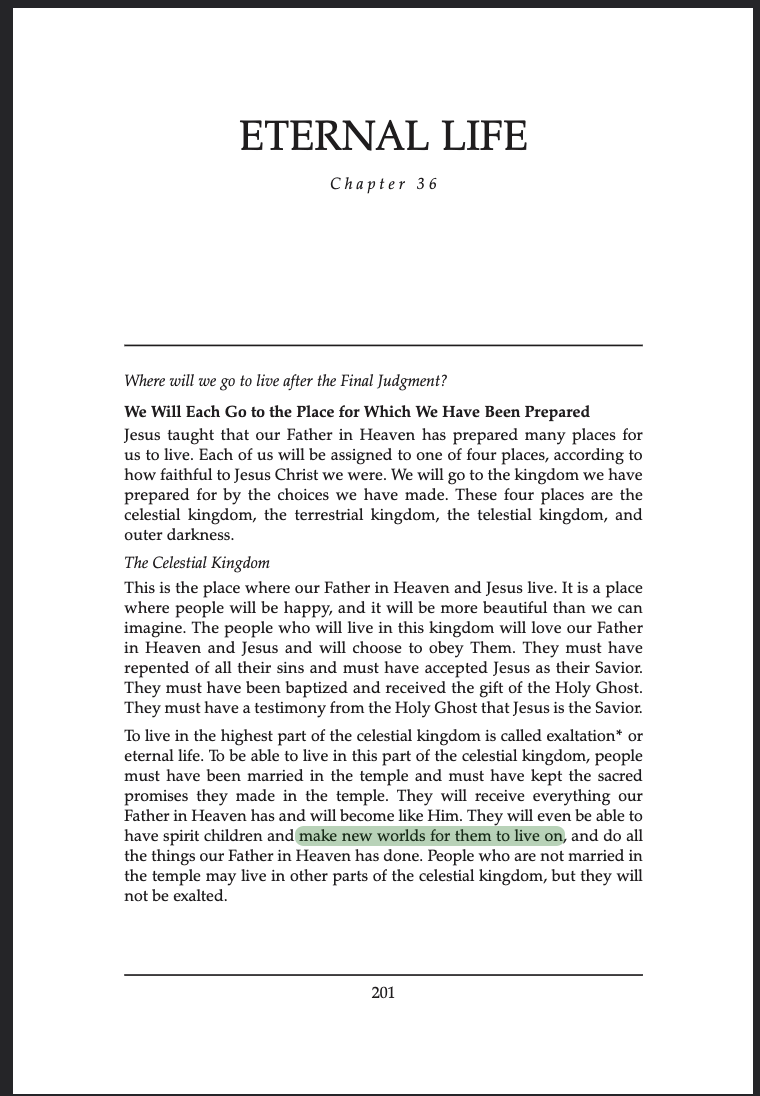
The manual does not use the phrase “getting your own planet.” It teaches that exalted members will make new worlds for their spirit children to inhabit. This is the substance underlying the common “own planet” characterization.
The Church’s Newsroom FAQ, question 12, now answers:
Do Latter-day Saints believe that they will “get their own planet”? No. This idea is not taught in Latter-day Saint scripture, nor is it a doctrine of the Church. This misunderstanding stems from speculative comments unreflective of scriptural doctrine. Latter-day Saints believe that we are all sons and daughters of God and that all of us have the potential to grow during and after this life to become like our Heavenly Father (see Romans 8:16-17). The Church does not and has never purported to fully understand the specifics of Christ’s statement that “in my Father’s house are many mansions” (John 14:2).
The Gospel Topics essay “Becoming Like God” similarly reframes the teaching:
Latter-day Saints’ doctrine of exaltation is often similarly reduced in media to a cartoonish image of people receiving their own planets. … while few Latter-day Saints would identify with caricatures of having their own planet, most would agree that the awe inspired by creation hints at our creative potential in the eternities.
2. God was once a man; man can become like God
Chapter 36 states that God the Father was once a man (p. 204):
It will help us to remember that our Father in Heaven was once a man who lived on an earth, the same as we do. He became our Father in Heaven by overcoming problems, just as we have to do on this earth. However, the Prophet Joseph Smith said we will not learn everything we need to learn while in this world. It will take us a long time after we complete this life to know all the things we need to know in order to become like our Father in Heaven.
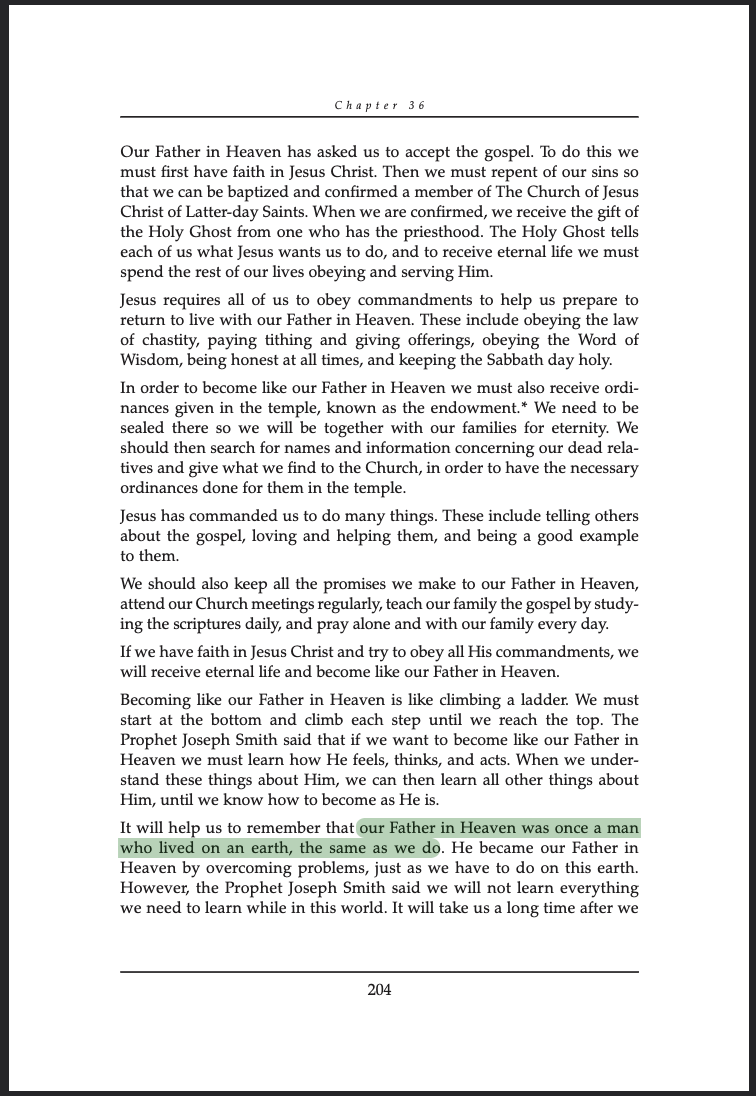
The same chapter frames man’s potential to become like God as a direct climb toward divinity (p. 204):
Becoming like our Father in Heaven is like climbing a ladder. We must start at the bottom and climb each step until we reach the top. The Prophet Joseph Smith said that if we want to become like our Father in Heaven we must learn how He feels, thinks, and acts. When we understand these things about Him, we can then learn all other things about Him, until we know how to become as He is.
The Gospel Topics essay “Becoming Like God” now qualifies the first half of the couplet “As man now is, God once was”:
Lorenzo Snow, the Church’s fifth President, coined a well-known couplet: “As man now is, God once was: As God now is, man may be.” Little has been revealed about the first half of this couplet, and consequently little is taught. When asked about this topic, Church President Gordon B. Hinckley told a reporter in 1997, “That gets into some pretty deep theology that we don’t know very much about.” When asked about the belief in humans’ divine potential, President Hinckley responded, “Well, as God is, man may become. We believe in eternal progression. Very strongly.”
The Newsroom FAQ, question 11, frames the doctrine as commonly misrepresented:
Do Latter-day Saints believe they can become “gods”? Latter-day Saints believe that is God’s purpose to exalt us to become like Him. But this teaching is often misrepresented by those who caricature the faith. The Latter-day Saint belief is no different than the biblical teaching, which states, “The Spirit itself beareth witness with our spirit, that we are the children of God: and if children, then heirs; heirs of God, and joint-heirs with Christ; if so be that we suffer with him, that we may be also glorified together” (Romans 8:16-17).
Appendix A: Provenance
Gospel Fundamentals was published by The Church of Jesus Christ of Latter-day Saints, Salt Lake City, Utah, and is © 1992, 2002 by Intellectual Reserve, Inc.


Appendix B: Context (Preface)
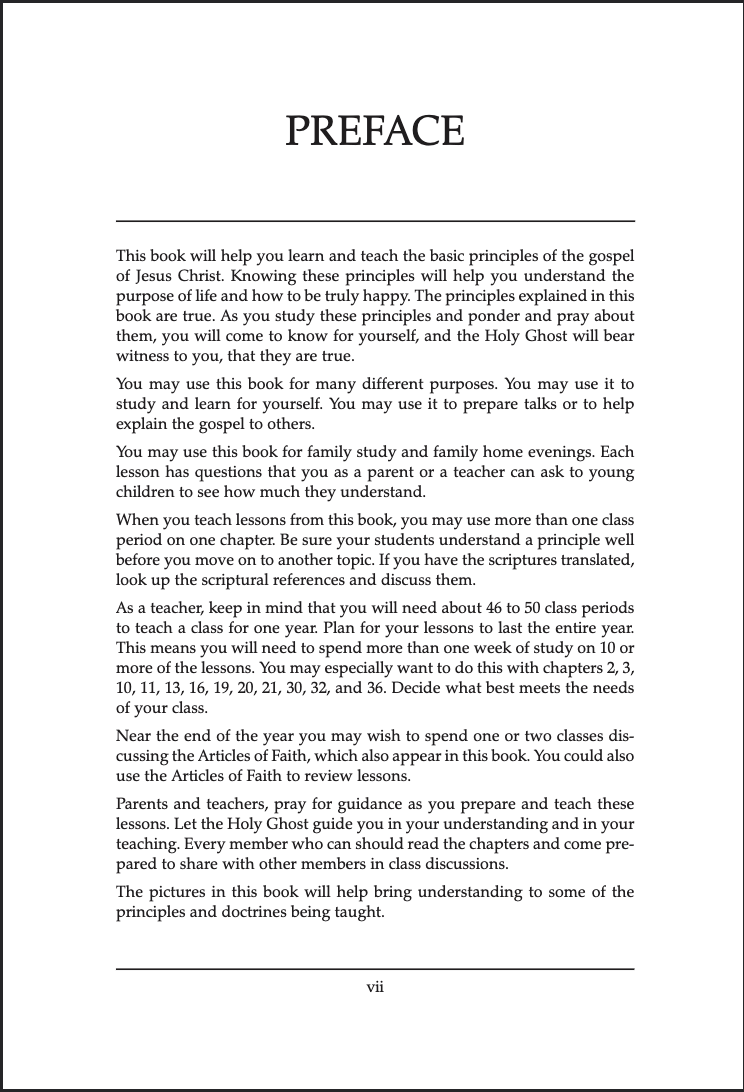
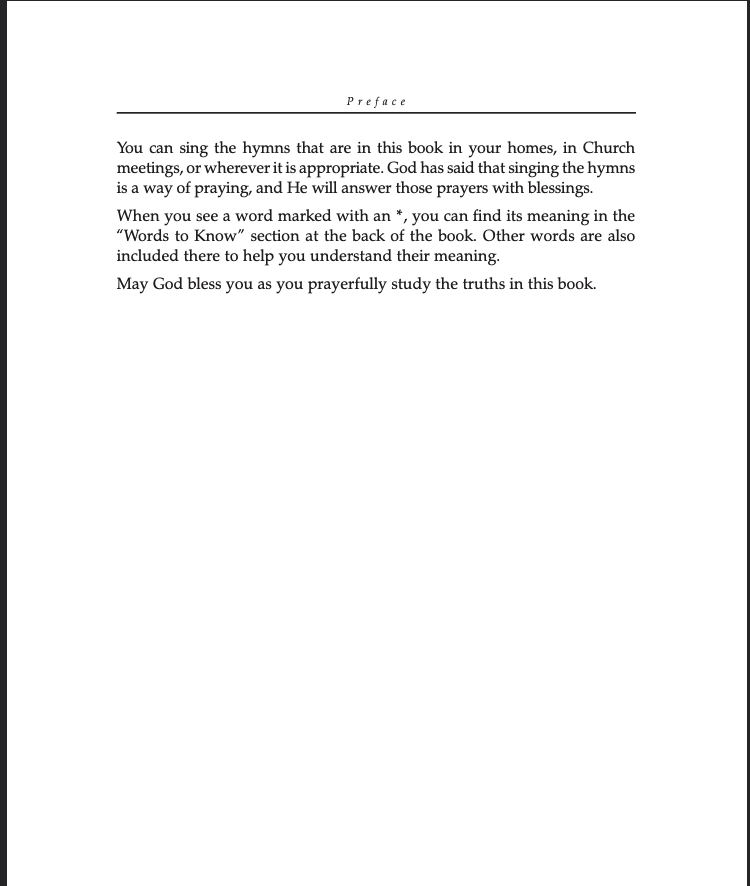
The Preface states without qualification that the book’s teachings are true (p. vii):
The principles explained in this book are true. As you study these principles and ponder and pray about them, you will come to know for yourself, and the Holy Ghost will bear witness to you, that they are true.
Sources
- Gospel Fundamentals (The Church of Jesus Christ of Latter-day Saints, Salt Lake City; © 1992, 2002 Intellectual Reserve, Inc.) — p. vii, p. 201, p. 204.
- “Becoming Like God,” Gospel Topics Essays (2016).
- “Frequently Asked Questions,” Newsroom, questions 11 and 12.